
The POD Sits in Your Driveway. Load It Like It's Going Cross-Country.
PODS, U-Pack, 1-800-PACK-RAT — the containers look forgiving because you can walk in and out. They're not. That container gets picked up, hauled across town or across the country, and set down without much care. Hire movers who load it like it's about to hit the highway.
Here's what usually goes wrong — and how this works instead
- Movers experienced with PODS, U-Pack, and 1-800-PACK-RAT
- Straps and pads brought by the crew, not rented last-minute
- Weight balanced correctly for pickup and transport
- Time your booking around your container drop-off window
- Container-loading history shown on every profile
- Damage claims from transit tracked publicly
- Verified equipment lists on each mover
What is pod loading labor?
POD loading help is labor for loading portable storage containers dropped in your driveway or a staging lot. Common for local moves, long-distance moves, and temporary storage during renovations.
Who needs this service
When to book this service
- The container is scheduled for pickup within 24–72 hours
- You want the container loaded in a single day
- You have furniture and boxes that can't shift in transit
- You want to fit everything in one container instead of two
What you get
Common mistakes to avoid
What to look for in a mover
- Movers with POD loading listed in their skills
- Reviews mentioning tight, balanced loads with no damage
- Willingness to use straps and blankets
- Experience with the specific container brand you're using
Recommended crew size
Two movers for a standard 8-foot or 12-foot POD. Three for a 16-foot POD or when the load has to happen in a single half day.
Equipment used on this job
Why experience matters
Containers get lifted, tilted, and set down on a lift system. A well-loaded POD has weight distributed evenly, tall items strapped upright, and heavy items low and against the walls. That's the difference between a smooth drop-off and finding your dresser on top of your TV.
Containers reward good loading more than trucks do
A portable container gets picked up, driven, lifted, set down, and sometimes stored for weeks. Everything inside experiences more vertical movement than it would in a rental truck, so the load has to be tight, tiered, and strapped rather than merely stacked.
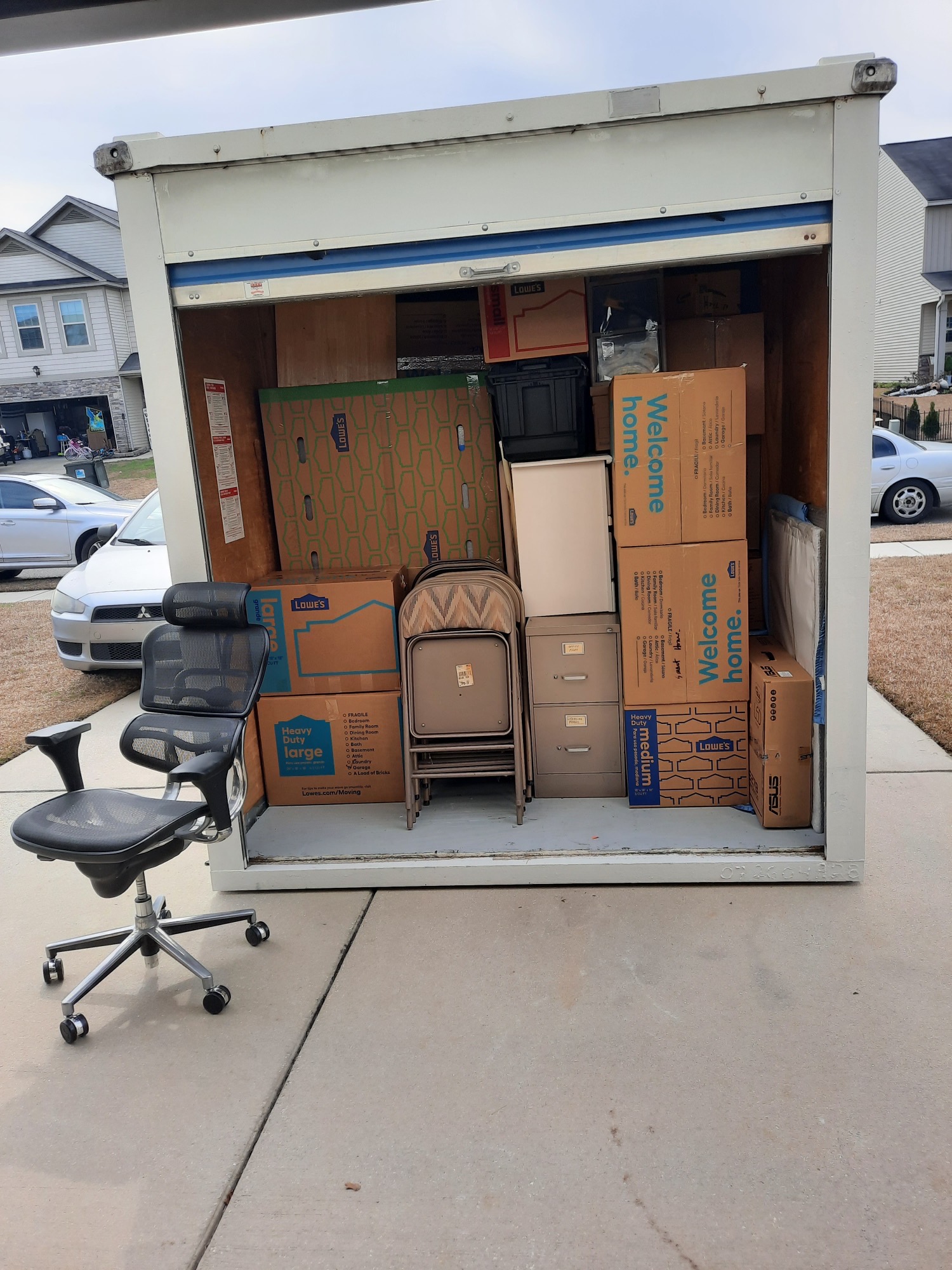
The right approach is a wall-to-wall build. Heavy, flat items go against the back wall on the floor. Furniture stands on end where it can, blanket-wrapped, with strap rails used every three or four feet. Boxes fill the middle in even courses, heaviest at the bottom. The last two feet nearest the door get the lightest, most awkward pieces, because that is the section that shifts most in transit.
If your container is going into storage, leave a narrow center aisle if you will need access, and keep anything moisture-sensitive off the floor on a pallet or a layer of blankets.
Container sizes and what they hold
| Container | Holds roughly | Crew size | Typical hours |
|---|---|---|---|
| 7–8 ft | Studio or a single room | 2 movers | 1.5–2 hours |
| 12 ft | 1–2 bedroom apartment | 2–3 movers | 2–3 hours |
| 16 ft | 2–3 bedroom home | 3 movers | 3–4.5 hours |
| Two 16 ft | 4+ bedroom home | 3–4 movers | 5–7 hours |
- Container placement needs a flat surface roughly 12 feet wide and 15 feet of overhead clearance
- Many HOAs and cities cap how many days a container can sit on the street — confirm before delivery
- Book labor for the day after delivery, not the day of, in case the drop window slips
Common container mistakes
- Loading loose and hoping straps hold it — voids are what cause damage, not the drive
- Putting the mattress flat on the floor of the container instead of on edge along a wall
- Leaving drawers full in a dresser that will be lifted twice by a forklift
- Forgetting that the last thing in is the first thing out — load essentials near the door
- Skipping a moisture barrier for a container that will sit in storage through a humid summer
Where the container goes, and who has to approve it
Container placement is a permission problem more often than a space problem. You need a flat surface about 12 feet wide with 15 feet of overhead clearance, no low branches or wires, and a delivery truck path that does not cross soft ground or a fresh driveway.
Then come the rules. Many HOAs cap how many days a container can sit in a driveway, and some prohibit street placement entirely. Cities frequently require a permit for a container in the public right of way. Apartment complexes usually assign a specific spot and time window. Sort all of that before you schedule the drop, not after.
Book your loading crew for the day after delivery. Container drop windows slip regularly, and a crew waiting on a truck is a crew on the clock.
Loading order that saves you at the other end
- Back wall: heavy, flat, uniform items — appliances, dressers, filing cabinets
- Middle: boxes in even courses, heaviest at the bottom, no voids left open
- Along the sides: mattresses and upholstered pieces on edge, blanket-wrapped
- Strap every three to four feet using the container's rails, not just at the end
- Front two feet by the door: light, awkward items and the boxes you will need first
- Storage-bound loads: leave a narrow center aisle and raise anything moisture-sensitive off the floor
Moving help matched to your needs
Post the move as POD loading and specify the container size. We use those details to match qualified container-loading help.